
If you’ve noticed that streetlights suddenly have a halo around them, or that reading the newspaper feels like squinting through fog, you might be tempted to blame it on tiredness, old spectacles, or “just getting older.” Sometimes, though, it’s something more specific – cataracts.
Cataracts develop slowly, which is exactly why they’re so easy to ignore in the beginning. Most people don’t wake up one day with blurry vision; it creeps in over months or years, and by the time it’s obvious, daily life has already quietly gotten harder. At Jeevan Jyoti Eye Hospital in Lucknow, we see this pattern often – patients who waited “just a little longer” and ended up dealing with vision loss that could have been treated much earlier.
Here are five early signs that your eyes may be telling you it’s time for a cataract check-up – before things progress toward complete blindness.
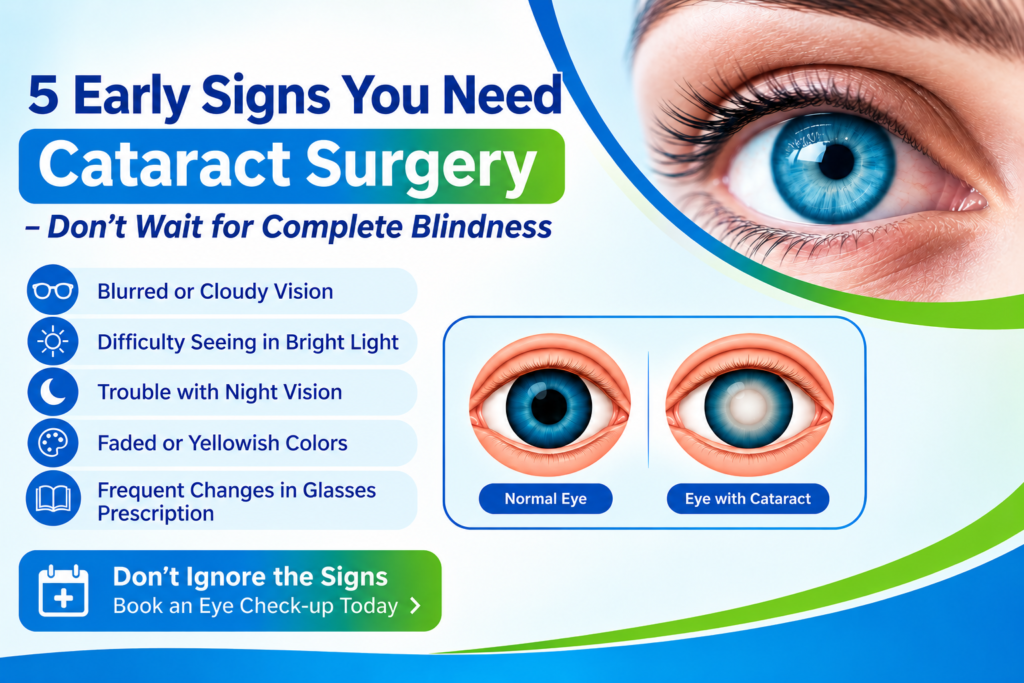
1. Blurry or Cloudy Vision That Doesn’t Improve With New Glasses
This is usually the first thing people notice. Objects that used to look sharp start appearing slightly hazy, as if you’re looking through a dusty window or a foggy windshield. What makes this different from a normal vision change is that updating your spectacle prescription doesn’t really fix it – because the problem isn’t your lens power; it’s the natural lens inside your eye clouding over.
If you’ve changed glasses once or twice in the last year and your vision still feels “off,” that’s a signal worth paying attention to, not brushing aside.
2. Increased Sensitivity to Light and Glare
Do headlights on the highway suddenly feel blinding? Does bright sunlight make you squint more than it used to? Glare sensitivity is one of the more disruptive early symptoms of cataract, mainly because it affects night driving – often the first activity people quietly start avoiding.
Some patients describe it as a “starburst” effect around lights, or a general glow that makes it hard to focus on anything else nearby. If this is happening regularly, it’s one of the classic early cataract symptoms in Lucknow’s dusty, high-glare traffic conditions especially.
3. Halos Around Lights
Related to glare, but distinct enough to mention on its own – halos are rings of light that appear around bulbs, headlamps, or even the moon. This happens because the clouded lens scatters light instead of letting it pass through cleanly to the retina.
Halos are often one of the earliest and most consistent signs, appearing even before vision blur becomes noticeable during the day.
4. Fading or Yellowing of Colors
Cataracts are not only responsible for blurring vision but also cause changes in colour perception. Whiteness becomes tinted with a slight shade of yellow or brownish hue, and all colours may appear less vivid than before. The changes occur so slowly that most patients fail to notice them by themselves. Instead, it is usually their relatives or friends who tell them that “the shirt isn’t really white” or that the pictures do not match the description.
This symptom is a strong indicator that the natural lens is clouding, since it directly changes how light and color reach the retina.
5. Frequent Changes in Eyewear Prescription
If you find yourself back at the optician’s every few months because your glasses “don’t feel right anymore,” that repeated instability in your prescription can be an early cataract sign. As the lens changes shape and clarity, your refractive error keeps shifting too – which is why no single pair of glasses seems to work for long.
This is different from normal age-related presbyopia, which stabilizes. Cataract-related changes tend to keep progressing.
When Should Cataract Be Operated?
This is one of the most common questions we get at our clinic, and there’s no single “right” stage for everyone. In general, cataract surgery is recommended when the cloudiness starts interfering with daily activities – reading, driving, cooking, recognizing faces, or working comfortably. You don’t have to wait until vision is completely gone.
In fact, waiting too long can make surgery more complex, since a very mature (advanced) cataract is denser and takes longer to remove safely. Early-to-moderate stage cataracts are generally easier to operate on, with quicker recovery and better outcomes.
Can Cataracts Cause Complete Blindness If Left Untreated?
Yes – if left untreated indefinitely, a cataract can progress to the point of significant, and eventually near-total, vision loss in the affected eye. The encouraging part is that cataract-related blindness is almost entirely preventable with timely surgery. Unlike some other eye conditions, cataracts don’t cause irreversible damage to the optic nerve on their own in most cases, which means restoring vision through surgery is usually very effective even at later stages – though earlier is always safer and simpler.
Don’t Wait for “Complete” Symptoms
A lot of patients tell us they were waiting for things to get “bad enough” before seeing a doctor. But cataract isn’t something that needs to reach a crisis point before treatment. If even one or two of the signs above sound familiar, it’s worth getting a proper eye examination rather than guessing.
At Jeevan Jyoti Eye Hospital, our professionals have expertise in identifying cataracts at an early stage and provide thorough eye examinations that will help detect such changes in your vision before they start hampering your life. Being amongst the well-known names in Lucknow for Cataract treatment and surgery, we combine the expertise of our eye doctors along with state-of-the-art equipment, which will assist you in finding the right time for your treatment.
Noticing blurry vision, glare, or halos around lights? Book a cataract screening with our specialists in Lucknow today, and take the first step toward clearer, worry-free vision.