If your doctor has told you it’s time for cataract surgery, the first thing on your mind probably isn’t the lens type or the technique – it’s “what’s this going to cost me?” That’s a completely fair question, and honestly, it’s one we get asked in almost every consultation.
Here’s the thing, though: there’s no single number we can give you upfront, and any hospital that quotes you a flat figure without examining your eyes first isn’t giving you the full picture. Cataract surgery cost in Lucknow genuinely varies from person to person, because the price depends on your eye’s condition, the lens you choose, and the surgical approach that’s right for you. This guide walks you through exactly what drives that price up or down — so that when you do sit down for a consultation, you already know what questions to ask.
Why can’t hospitals give a fixed price over the phone?
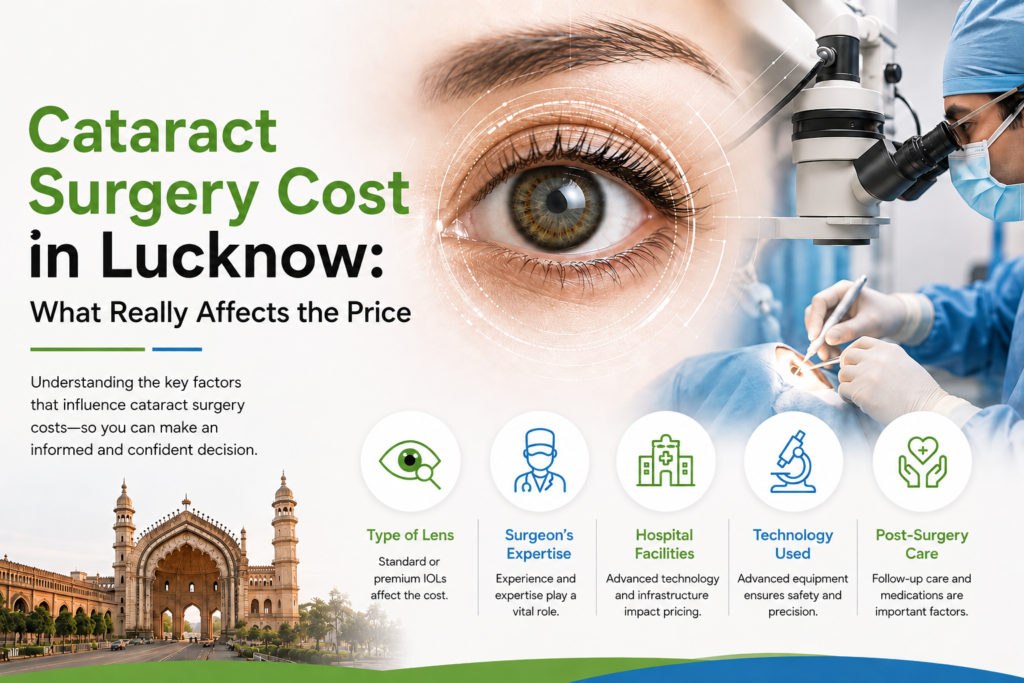
Because cataract surgery isn’t a one-size-fits-all procedure. Two people with “a cataract” can need very different things – one might have a straightforward case suited to a standard lens, while another might also have astigmatism, a denser cataract, or other eye conditions that call for a different lens or technique altogether. Your final cost is really a reflection of what your eyes specifically need, decided after a proper eye examination – not a menu price.
That said, understanding the factors that go into the final number can help you budget realistically and ask the right questions when you compare options.
The real factors that move the price up or down
1. Type of intraocular lens (IOL)
This is usually the single biggest factor. A basic monofocal lens – which gives clear vision at one distance, usually far- is the standard, well-established option and works well for a large number of patients. Premium lenses cost more because they’re designed to correct additional vision issues (like astigmatism, or the need for both near and far vision) in the same surgery, which naturally adds to the price.
2. Surgical procedure
Classic phacoemulsification is the well-tried and proven method that works perfectly well for decades and is the cheapest way. Laser-assisted methods involve the use of extra sophisticated equipment for some stages of the procedure, and this determines the price.
3. Surgeon’s experience and hospital infrastructure
The surgeon’s experience, amount of operations he/she performs and the operation theatre standards of the hospital determine the price and this is completely justified.
It’s worth thinking of this less as “expensive vs. cheap” and more as “what level of care and equipment am I paying for.”
4. What’s included before and after surgery
A responsible cost estimate isn’t just the time spent in the operating room. It includes your pre-surgery eye tests and measurements (used to calculate your exact lens power), the medications, and the follow-up visits afterward. A quote that skips these and only covers the “surgery” itself often isn’t the full picture — always ask what’s included.
5. Whether both eyes need surgery
Many patients eventually need both eyes treated, though surgeons typically do one eye at a time, spaced a few weeks apart for safe healing. It’s worth asking your hospital whether they offer any consideration for patients booking both eyes.
Toric vs. Multifocal lens: what’s the real difference?
This comes up a lot, so let’s break it down simply.
- Toric lenses are built for people with astigmatism — an irregular curve in the cornea that causes blurred or shadowed vision. They correct that specific issue so you get sharp vision at one distance.
- Multifocal lenses (and trifocal variants) go a step further, aiming to reduce your dependence on glasses altogether by creating multiple focal points for both near and far vision.
Because multifocal lenses involve more advanced optical design, they generally sit at a higher price point than toric lenses. But which one – if either – is right for you isn’t really a budget decision first. It depends on your corneal shape, the health of your retina, and how you actually use your eyes day to day (do you drive at night, read a lot, spend hours on screens?). Your surgeon will be able to tell you honestly whether a premium lens will meaningfully improve your day-to-day vision, or whether a standard lens serves you just as well.
Is cataract surgery covered under insurance in Lucknow?
Yes, in most cases. Most health insurance companies in India cover cataract surgery, though there may be a cap on the maximum amount the insurer will pay. A few things worth knowing before your surgery:
- Cashless treatment is common at network hospitals. If you choose a network hospital for your cataract surgery, you can avail of cashless treatment, allowing your insurer to settle the eligible bills directly with the hospital.
- Sub-limits often apply on premium lenses. Standard monofocal surgery tends to be well covered, but insurers frequently cap how much they’ll contribute toward a toric or multifocal lens upgrade — meaning the difference may come out of pocket.
- It’s usually treated as a day-care procedure, since patients are typically discharged the same day, so you don’t need a 24-hour hospital stay for the claim to be valid.
- Senior citizen and family floater plans often have their own cataract-specific terms, so it genuinely pays to check your policy document or call your insurer before your surgery date, rather than assuming.
The best move here is simple: before your surgery date is finalised, ask your hospital’s insurance team to verify your coverage and pre-authorise it. It saves you from any surprises when the final bill comes.
What to actually ask for when you’re comparing hospitals
Rather than comparing a single number across hospitals, ask each one for an itemised breakdown that covers:
- Pre-operative eye tests and lens power calculation
- Surgeon’s fee and operation theatre charges
- The intraocular lens itself
- Anaesthesia and medications
- Post-operative follow-up visits over the following weeks
A hospital quoting the lowest headline figure isn’t automatically the most affordable one once these are billed separately later. Transparency upfront tends to be the better indicator of a fair price.
Finding a trusted cataract surgeon near Ashiyana and LDA Colony, Lucknow
If you’re based around Ashiyana, LDA Colony, or nearby parts of Lucknow, here’s what’s genuinely worth prioritising when choosing where to get treated:
- An experienced, qualified ophthalmic surgical team
- Honest, itemised estimates — not vague “starting from” figures that grow later
- In-house diagnostic and biometry facilities, so your lens power is measured accurately on-site
- Support navigating insurance and cashless claims
- Easy access for the 2–3 follow-up visits you’ll need in the weeks after surgery
At Jeevan Jyoti Eye Hospital in LDA Colony, our approach is simple: we examine your eyes first, explain your options honestly, and only then talk numbers – so you know exactly what you’re paying for and why. If you’re planning, the most useful next step isn’t searching for a price online; it’s booking an eye evaluation so we can give you an answer specific to your case.