
Here’s the uncomfortable fact about Glaucoma Symptoms: most people who have it don’t know they have it. Not because they’re ignoring symptoms – because there usually aren’t any until a meaningful chunk of vision is already gone. That’s not scare-mongering; it’s just how the disease behaves, and it’s exactly why it’s earned the nickname “the silent thief of sight.”
If you’re past 40, this is one of those blog posts worth actually finishing, not skimming.
Why glaucoma doesn’t announce itself
Vision loss from glaucoma almost always starts at the edges – your peripheral vision – long before it touches the sharp, central vision you rely on for reading or recognizing faces. The brain is also remarkably good at filling in gaps using information from both eyes, so a person can lose a surprising amount of peripheral vision in one eye and simply not notice, because the other eye is quietly compensating.
By the time someone does notice a change – vision narrowing, like looking through a tunnel – the optic nerve has usually already sustained damage that can’t be reversed. That’s the core problem with Glaucoma Symptoms: it’s very manageable if caught early, and permanent if caught late. There’s no in-between “catch it whenever” option.
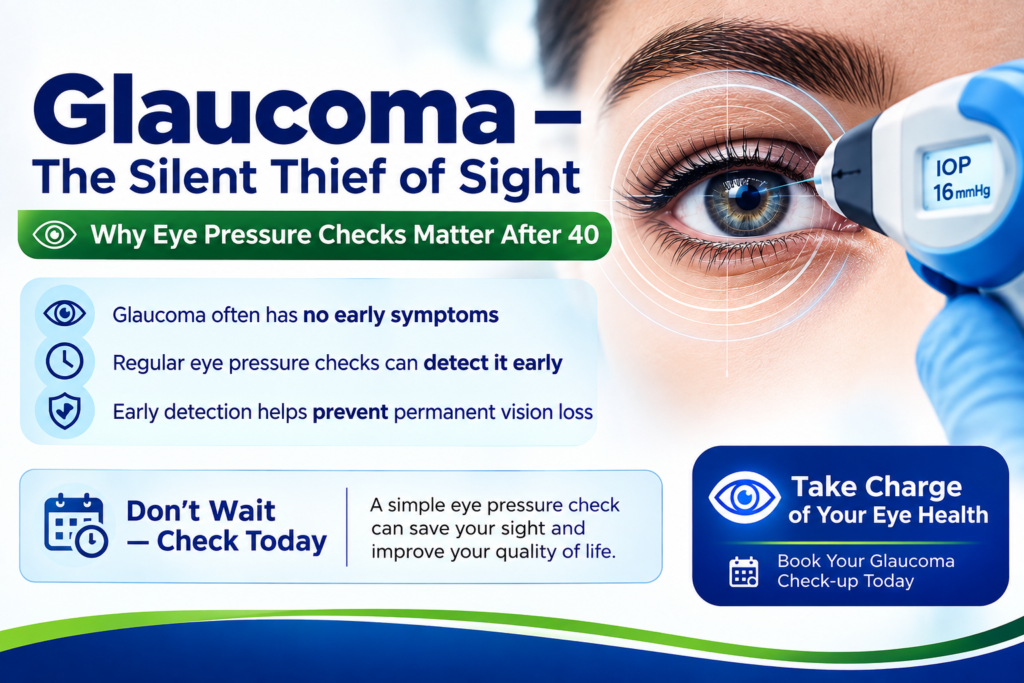
What’s actually going on inside the eye
The eye constantly produces and drains a clear fluid called aqueous humor, which keeps the eye’s shape and pressure stable. Glaucoma typically develops when that drainage system doesn’t work efficiently – fluid builds up faster than it drains, intraocular pressure rises, and over time that elevated pressure damages the optic nerve, the cable that carries visual information from your eye to your brain. Once optic nerve fibers are damaged, they don’t regenerate, which is the whole reason early detection carries so much weight with this particular disease.
It’s worth noting that glaucoma can, less commonly, develop even with normal eye pressure – which is part of why a pressure check alone isn’t a complete evaluation, and why a proper glaucoma screening looks at the optic nerve directly, not just the number on a tonometer.
Who should be paying closer attention
Age is the biggest factor – risk rises meaningfully after 40 and continues climbing with each decade. Beyond that, a few things push individual risk higher:
– Family history – having a parent or sibling with glaucoma raises your own risk considerably, since the disease has a clear hereditary component
– Diabetes and high blood pressure, both of which affect blood flow to the optic nerve
– High myopia (nearsightedness), which is associated with certain glaucoma types
– Long-term steroid use, including some steroid eye drops, which can raise eye pressure
– Previous eye injury or eye surgery
If more than one of these applies to you, the “wait until something feels off” approach really doesn’t work here – regular screening is the only practical safeguard.
The types worth knowing about
Primary open-angle glaucoma is the most common form, developing slowly over years with no early symptoms – genuinely silent, in the way the nickname suggests.
Angle-closure glaucoma behaves very differently. It can develop gradually, or it can strike suddenly – a genuine eye emergency involving eye pain, headache, blurred vision, halos around lights, nausea, and a red eye. This version isn’t silent at all; it demands same-day medical attention.
Normal-tension glaucoma causes optic nerve damage despite eye pressure staying within the normal range, which is precisely why an exam needs to look at the nerve itself rather than pressure numbers alone.
Secondary glaucoma develops as a consequence of another condition – an eye injury, inflammation, certain medications, or advanced diabetic eye disease, for instance.
What a proper glaucoma screening involves
A thorough evaluation goes well beyond a quick pressure reading. It typically includes tonometry to measure intraocular pressure, a visual field test to check for early peripheral vision loss, and an examination of the optic nerve itself – often through dilated exam or optical coherence tomography (OCT) imaging, which can pick up subtle nerve fiber changes before they show up as a noticeable symptom or even a visual field defect. Corneal thickness (pachymetry) is also often measured, since it affects how eye pressure readings should be interpreted for that particular eye.
None of this is uncomfortable, and the whole screening usually fits into a single visit.
Is glaucoma curable?
No – and this is worth being direct about, since it’s one of the most common questions people ask. There’s currently no cure that reverses optic nerve damage or restores vision already lost. What glaucoma treatment actually does is slow or halt further progression, which is exactly why the “catch it early” message matters so much: the vision you have at diagnosis is generally the vision you get to keep, provided the disease is then managed consistently.
Treatment usually starts with prescription eye drops to lower eye pressure, and can progress to laser treatment (like selective laser trabeculoplasty) or, in more advanced or resistant cases, surgical procedures that improve fluid drainage from the eye. The right approach depends entirely on the type and stage of glaucoma, which is why self-diagnosing from a symptom list online isn’t a substitute for an actual exam.
Warning signs that need urgent attention, not routine scheduling
– Sudden eye pain, especially paired with headache and nausea
– Sudden blurred vision or halos around lights
– A red, painful eye that comes on quickly
– Noticeable narrowing of your side vision
These point toward acute angle-closure glaucoma or another urgent eye issue, and they warrant same-day care rather than the next available routine slot.
What we emphasize to patients at Jeevan Jyoti Eye Hospital
Dr. Paramjeet Singh, who has spent close to two decades managing glaucoma and other eye conditions in Lucknow, is fairly blunt with patients about this disease specifically: it’s one of the few eye conditions where “I’ll get it checked when something feels wrong” genuinely doesn’t work, because by the time something feels wrong, the damage has usually already happened. Screening at Jeevan Jyoti Eye Hospital includes direct optic nerve assessment alongside pressure testing – not pressure readings in isolation – since normal-tension glaucoma can otherwise slip through unnoticed.
If you’re over 40, have a family history of glaucoma, or simply can’t remember your last eye pressure check, that’s reason enough to book one.
Conclusion
Glaucoma doesn’t give you a warning shot. The vision it takes doesn’t come back, and the only real defense is catching it before it starts taking anything at all. If you’re over 40 and it’s been a while since your last comprehensive eye exam, that’s not a “someday” item — it’s worth putting on the calendar this month.