
If your doctor has told you that you have a cataract, it is normal to feel a little worried. Most people ask the same questions: Will it hurt? How long will it take? When can I go back to normal life? How much will it cost?
The good news is that cataract surgery is one of the safest and most commonly performed procedures in the world, and modern technology has made it even more precise. This guide explains laser cataract surgery in Lucknow in simple language, so you know exactly what to expect at every stage.
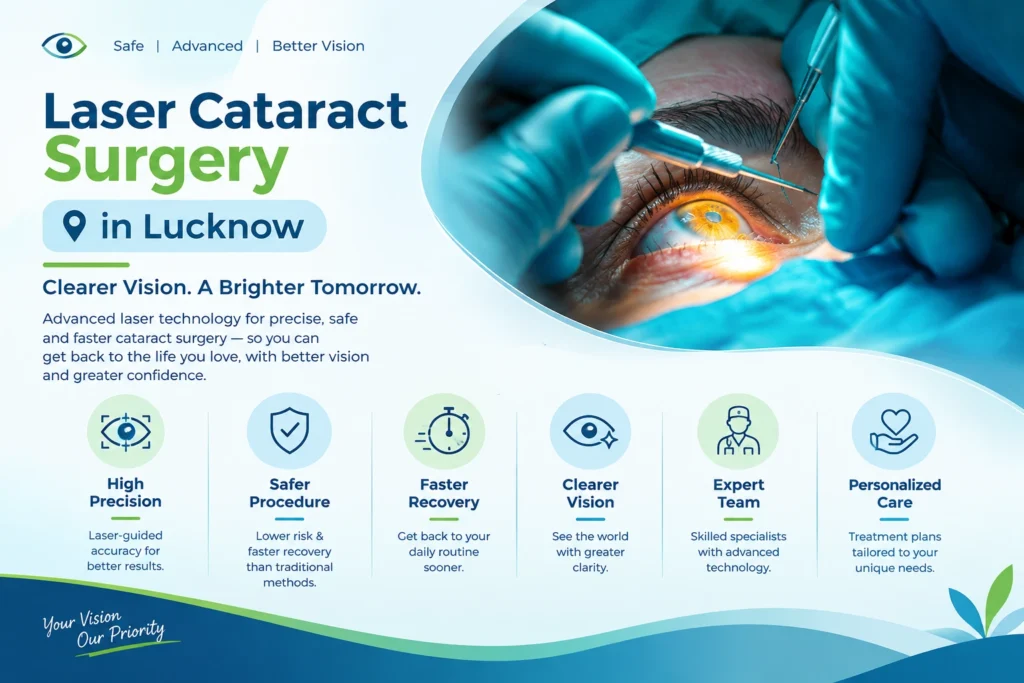
Laser cataract surgery is an advanced way of removing a cloudy natural lens and replacing it with a clear artificial lens, using a laser for some of the most delicate steps. It is usually done as a day-care procedure, takes about 15 to 30 minutes per eye, and most people notice clearer vision within a few days.
What Is a Cataract, and When Do You Need Surgery?
A cataract is the clouding of the eye’s natural lens. Think of looking through a foggy or frosted window. Cataracts usually develop slowly, most often with age, but diabetes, eye injury, long-term steroid use, smoking and prolonged sun exposure can also play a role.
Common signs include:
- Blurry, hazy or dim vision
- Glare or halos around lights, especially while driving at night
- Colours looking faded or yellowish
- Frequent changes in glasses power
- Difficulty reading, watching TV or recognising faces
There is no medicine or eye drop that can reverse a cataract. Glasses may help in the early stage, but once the cataract affects your daily life, surgery is the only permanent treatment. To learn more about the condition and treatment options, you can read our detailed page on cataract surgery at Jeevan Jyoti Eye Hospital.
What Is Laser Cataract Surgery?
Laser cataract surgery (also called femtosecond laser-assisted cataract surgery) uses a computer-guided laser to perform key steps that surgeons traditionally did by hand with a blade.
The laser helps with:
- Creating the incisions in the eye with high precision
- Opening the lens capsule (the thin bag that holds the lens) in a neat, circular shape
- Softening and breaking the cataract into smaller pieces, so less ultrasound energy is needed to remove it
After this, the cataract is gently removed and a clear intraocular lens (IOL) is placed in the eye.
Is it painless? Yes, the eye is numbed with anaesthetic drops (or a gentle injection in some cases), so you should feel pressure but not pain.
Is it right for everyone? Not always. Whether laser-assisted surgery is suitable depends on your eye health, the type and density of your cataract, and other eye conditions. An eye specialist will examine you and recommend the best option. Many patients also do very well with advanced modern phacoemulsification, so the right choice is the one that suits your eyes.
Before Surgery: How to Prepare
Good preparation makes the day smoother and the result better.
Step 1: Detailed eye check-up. Your doctor will measure your eye’s shape and size, check the eye pressure, examine the retina and review your overall health. These measurements help choose the correct lens power.
Step 2: Choosing your lens. You may be offered different types of IOLs, such as monofocal lenses (clear vision at one distance, usually distance), and premium options like multifocal or toric lenses, which can reduce dependence on glasses or correct astigmatism. Ask your doctor which one fits your lifestyle.
Step 3: Medical clearance. If you have diabetes, high blood pressure or heart problems, make sure they are under control. Share a list of all your medicines with your doctor.
Step 4: Simple instructions on the day.
- Follow the fasting instructions given to you
- Take regular medicines only as advised
- Wear comfortable clothes and avoid makeup
- Bring a family member or friend with you, since you should not travel alone after surgery
During Surgery: What Happens Step by Step
Here is what a typical procedure looks like:
- Numbing: Anaesthetic drops are put in your eye. You stay awake but relaxed.
- Laser step: You lie comfortably under the laser, which maps your eye and completes the pre-programmed steps in about a minute or two.
- Lens removal: The softened cataract is gently removed through a tiny opening.
- Lens implant: A foldable artificial lens is placed in the same position as your natural lens.
- Finish: The small incision is usually self-sealing, often needing no stitches.
The whole process generally takes 15 to 30 minutes per eye, and most patients go home the same day. If both eyes need surgery, the second is usually done after a gap of a few days to weeks.
After Surgery: Recovery and Aftercare
Most people feel comfortable quickly, but healing still needs care. Here is what you can generally expect:
- First 24 hours: Mild scratchiness, watering or light sensitivity is normal. You will usually be given a protective shield or glasses.
- First week: Vision gets clearer day by day. Your doctor will review your eye the next day and again within the first week or so.
- 2 to 4 weeks: Most healing is complete. Vision stabilises, and if needed, your final glasses prescription is checked.
Do’s
- Use prescribed eye drops exactly on schedule
- Wash your hands before touching the drops or your face
- Wear the protective shield while sleeping, as advised
- Wear sunglasses outdoors
- Attend every follow-up visit
Don’ts
- Don’t rub or press your eye
- Avoid water, soap and dust getting into the eye in the first week
- Avoid heavy lifting, strenuous exercise and swimming until your doctor allows
- Avoid applying kajal or eye makeup during the early healing period
Call your eye doctor right away if you notice: severe pain, sudden drop in vision, increasing redness, discharge, or new flashes and floaters. These are uncommon, but early attention matters.
Laser Cataract Surgery Cost in Lucknow: What Affects the Price?
One of the first questions people ask is about the cost of laser cataract surgery. There is no single fixed price, because the total depends on a few factors:
- Type of technique: Laser-assisted surgery generally costs more than standard phacoemulsification because of the advanced technology involved.
- Type of intraocular lens: Standard monofocal lenses cost less than premium multifocal, extended-depth or toric lenses.
- Your eye condition: A very dense or complicated cataract may need extra time and care.
- Hospital facilities and surgeon experience: Technology, sterile operation theatres and follow-up care all contribute.
- Pre-surgery tests and medicines: Check whether these are included in the package.
- Insurance or government schemes: Some health insurance policies and schemes may cover part of cataract surgery, depending on the terms.
Our advice: Don’t choose based on price alone. Ask for a clear, itemised estimate that mentions the technique, lens type, tests, follow-up visits and any extra charges, so there are no surprises. To get an accurate estimate for your eyes, it is best to have a consultation with an eye specialist.
Benefits of Laser Cataract Surgery
- High precision in key surgical steps
- Gentler removal of the cataract, using less ultrasound energy in many cases
- Quick visual recovery for most patients
- Small incisions, usually no stitches
- Good option for patients considering premium lenses, where accuracy matters most
Why Choose Jeevan Jyoti Eye Hospital for Laser Cataract Surgery in Lucknow?
Choosing where to get your eyes treated is a matter of trust. At Jeevan Jyoti Eye Hospital, our approach is built around:
- Honest guidance: We explain all your options and recommend what is genuinely right for your eyes, not what is most expensive.
- Experienced eye specialists supported by modern diagnostic and surgical technology
- Clear communication: You will know what to expect before, during and after surgery
- Caring follow-up: Your recovery matters to us as much as the surgery itself
If you or someone in your family is facing blurred vision, you can learn more about our procedures and book a consultation through our cataract surgery page.
Final Thoughts
Cataract surgery can feel like a big decision, but with the right information and the right doctor, it is a smooth and life-changing experience. Many patients describe it as seeing the world in bright, clear colours again.
If blurry vision is affecting your daily life, don’t wait for it to get worse. An early check-up can help you plan the right treatment at the right time.
Disclaimer: This blog is for general information only and is not a substitute for professional medical advice. Please consult a qualified eye specialist for diagnosis and treatment.