Most parents notice it in a photograph before they notice it in real life – one eye looking slightly off-centre while the other looks straight at the camera. The immediate reaction is usually “maybe it’s just the angle.” Sometimes it is. Sometimes it’s squinty, and it’s worth knowing the difference before school admission season turns into the first time anyone actually looks closely.
What squint actually is
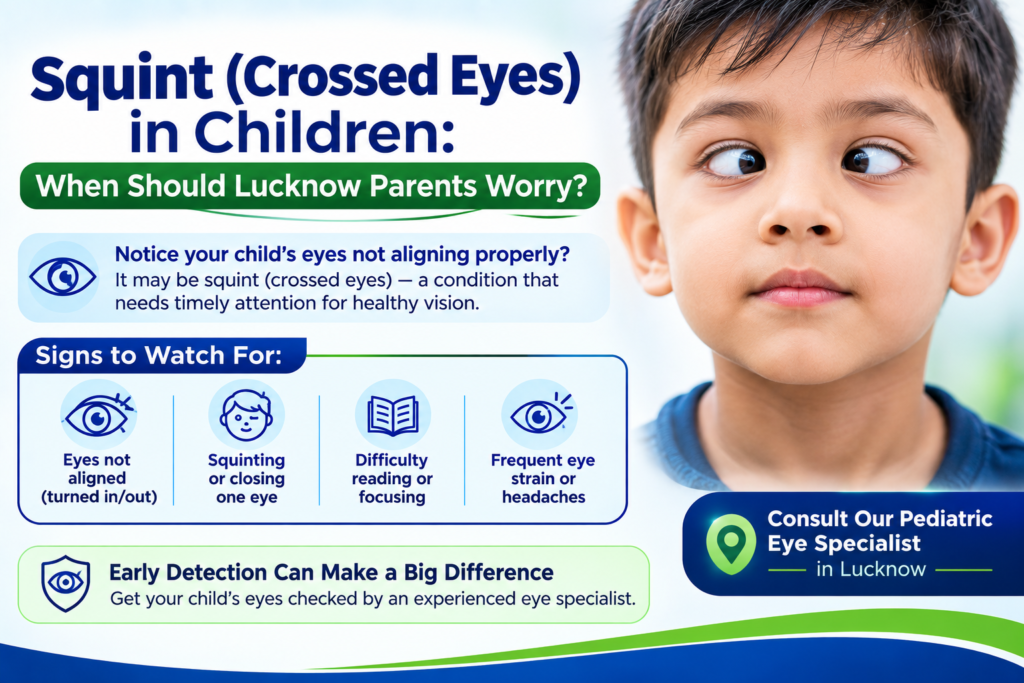
Squint – medically called strabismus – is when the two eyes don’t align in the same direction at the same time. One eye might turn inward, outward, upward, or downward while the other fixes normally on whatever the child is looking at. It can be constant, or it can come and go, showing up more when a child is tired, unwell, or concentrating hard on something close up, like a phone screen or a book.
It’s not just a cosmetic issue, even though that’s often what brings parents in first. When one eye consistently turns away from where it should be pointing, the brain often starts to ignore the input from that eye to avoid double vision. Over time, that ignored eye can develop amblyopia – commonly called lazy eye – where vision in that eye doesn’t develop properly, even though the eye itself is structurally normal. This is what makes early treatment genuinely time-sensitive, not just a matter of appearance.
What causes squint in children
There isn’t one single cause – it’s usually related to how the eye muscles, nerves, and brain coordinate to keep both eyes pointed at the same target. Some of the more common contributors:
- Refractive errors, especially significant farsightedness, which forces the eyes to work harder to focus and can pull one eye out of alignment
- Family history – squint runs in families more often than most parents expect
- Premature birth or low birth weight, which are associated with higher rates of eye alignment issues
- Underlying neurological or developmental conditions, in a smaller number of cases
- Sometimes, no clear cause is ever identified – the eyes simply don’t coordinate as expected, and treatment still works regardless of the exact reason
It’s also worth knowing that a small degree of eye misalignment is genuinely normal in newborns during the first few months as visual coordination develops. What’s not normal is misalignment that persists past around 4 months of age, or that appears suddenly in an older child.
Can squint be corrected without surgery?
Often, yes – and this tends to surprise parents who assume surgery is the only option. Treatment depends heavily on the type and cause:
- Glasses can fully correct squint caused by significant refractive error, particularly certain types of farsightedness, sometimes without any further intervention needed
- Patching therapy – covering the stronger eye for part of the day – forces the weaker eye to work, which is the standard treatment for amblyopia when it’s already developed
- Vision therapy or eye exercises can help certain types of squint, particularly ones related to eye coordination rather than pure muscle misalignment
- Surgery becomes the recommended option when misalignment is significant, doesn’t respond to glasses or patching, or when correcting the visible misalignment itself is the priority – squint surgery adjusts the eye muscles to bring the eyes into proper alignment, and is a well-established, routinely performed procedure in children
The honest answer is that no single approach fits every child – it depends entirely on what’s causing the misalignment, which is exactly why an actual eye exam matters more than guessing from a checklist online.
At what age should squint be treated?
Earlier is genuinely better here, and it’s not just a general “sooner is nicer” statement – it’s tied directly to how vision develops in young children. The visual system is most adaptable in the first several years of life, generally considered to extend up to around age 7 to 8. Amblyopia treatment tends to work fastest and most completely when started early in this window; the same treatment becomes progressively less effective the older a child gets, and much harder to correct once the visual system has largely finished developing.
This is really the core message worth repeating: a squint noticed at age 2 and treated promptly has a meaningfully better long-term outlook than the same squint left until age 6 or 7, simply because there’s more time left in that developmental window to work with.
Signs parents should actually watch for
- One eye visibly turning in, out, up, or down – constantly or intermittently
- A child consistently tilting or turning their head to look at things, which can be a way of compensating for misalignment
- Squinting or closing one eye in bright light
- Bumping into objects on one side, or clumsiness that seems more pronounced than expected
- Complaints of double vision, or a child rubbing their eyes frequently
- Poor performance on a school vision screening, even without an obvious visible squint
Some squints are subtle enough that even attentive parents miss them for months – which is exactly why a comprehensive pediatric eye exam matters even when nothing looks obviously wrong, especially before starting school.
Why school admission season is the moment parents actually notice
There’s a predictable pattern every year – pediatric eye clinics see a genuine uptick in squint and vision concerns right around school admission time, largely because it’s often the first occasion a child’s eyes get looked at closely and consistently by someone other than family: admission forms asking about vision, school screening requirements, or simply a parent noticing their child squinting at a whiteboard photo for the first time. If your child is heading into school this year, that’s actually a reasonable, low-pressure moment to fold in a comprehensive eye check alongside everything else on the admission checklist – not because something is necessarily wrong, but because it’s one of the easiest windows to catch something early if it is.
What a pediatric eye exam for squint involves
A proper evaluation is more thorough than the vision chart most adults picture. It typically includes assessing how well each eye tracks and aligns with the other, checking for refractive errors that might be contributing to the misalignment, and evaluating how well each eye’s vision has developed individually – since amblyopia can be present even when a squint itself isn’t obviously visible. For younger children who can’t yet read a standard eye chart, pediatric ophthalmologists use age-appropriate methods to assess alignment and vision, so age is rarely a barrier to getting a meaningful answer.
What we tell parents at Jeevan Jyoti Eye Hospital
Pediatric ophthalmology, including squint correction and lazy eye treatment, is one of the services offered at Jeevan Jyoti Eye Hospital under Dr. Paramjeet Singh, whose approach with younger patients centers on calm, unhurried examinations and clear explanations for parents – not just a diagnosis, but an honest sense of urgency (or lack of it) so families aren’t left guessing whether “wait and watch” is genuinely appropriate or just deferred worry. Given how squarely time-sensitive amblyopia treatment is, that clarity tends to matter more to parents than almost anything else in the visit.
If your child is heading into a new school year and hasn’t had a proper eye exam recently – or you’ve noticed anything from the list above, even if it seems minor – it’s worth getting looked at rather than waiting to see if it resolves on its own.
Conclusion
Squint in children is common, very treatable, and most successful when caught early – but “early” has a real deadline tied to how a child’s visual system develops, not just a general sense of urgency. If you’ve noticed anything that looks even slightly off in your child’s eyes, or it’s simply been a while since their last eye exam, getting it checked now costs very little and rules out a lot.
Noticing something in your child’s eyes, or gearing up for school admissions? Book a pediatric eye exam with Jeevan Jyoti Eye Hospital in LDA Colony, Ashiyana, Lucknow.