
If you’ve been diabetic for a few years and your eyes “feel fine,” that’s actually not the reassurance it sounds like. Diabetic retinopathy is one of those conditions that does real, sometimes irreversible damage long before you notice anything wrong with your vision. By the time symptoms show up, the disease has often already progressed past its easiest-to-treat stage.
This is the uncomfortable truth we end up explaining to a lot of patients at the clinic, usually after the fact rather than before. So here it is, upfront: if you have diabetes, an annual retina scan isn’t optional maintenance – it’s the one screening that catches this disease while it’s still quiet.
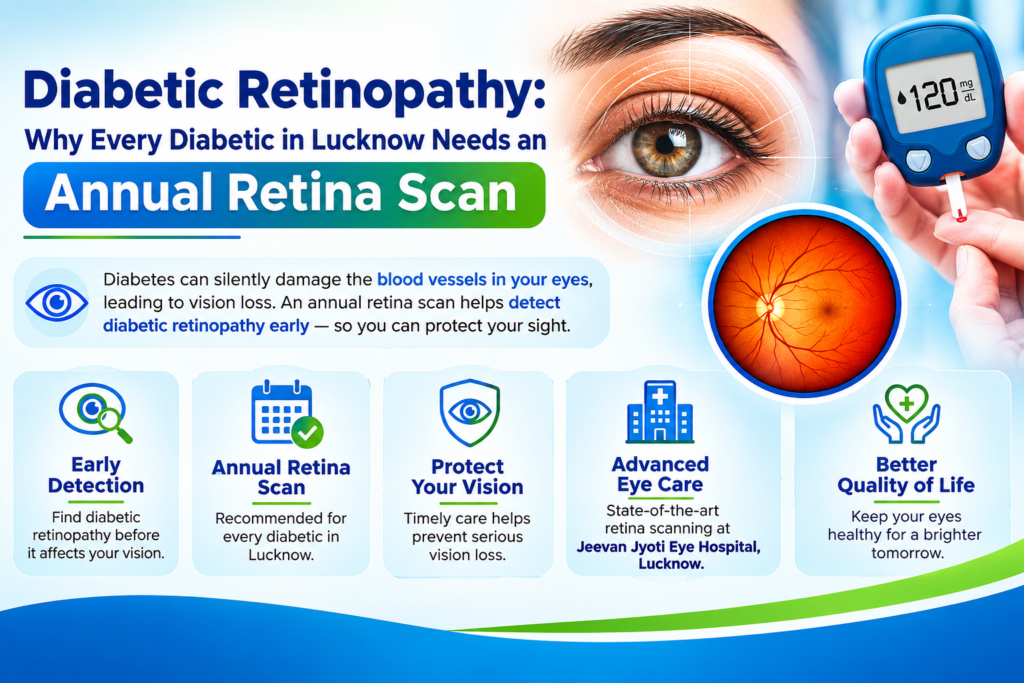
What’s actually happening inside the eye
Diabetes affects blood vessels throughout the body, and the retina – the light-sensitive tissue lining the back of the eye – happens to have some of the smallest, most delicate vessels around. Persistently high blood sugar weakens their walls over time. They start to leak fluid or blood, or the retina responds by starving for oxygen and sprouting new, fragile vessels that shouldn’t be there in the first place. Those new vessels are actually the more dangerous part – they bleed easily and can pull on the retina, sometimes leading to a detachment.
None of this tends to hurt. None of it necessarily blurs your vision early on. It just sits there, quietly progressing, until it reaches a point where damage to central vision is no longer reversible.
Why this matters more in Uttar Pradesh than the national conversation suggests
India carries one of the largest diabetic populations in the world, and Uttar Pradesh is no exception – the state has seen a steady rise in diagnosed diabetes over the past decade, tracking a broader urban shift toward sedentary lifestyles and diet changes. What we see in practice mirrors that: a growing number of patients coming in not for an eye complaint, but referred by their physician for a diabetic eye check, often years after their diabetes diagnosis rather than at the start of it.
That delay is the real problem. Diabetic retinopathy screening guidelines generally recommend a dilated eye exam at the time of diagnosis for type 2 diabetes, and within five years of diagnosis for type 1 – not “whenever it’s convenient” or “once vision starts changing.”
Who’s at higher risk
- Duration of diabetes – risk climbs the longer someone has had diabetes, regardless of how well it’s currently controlled
- Blood sugar control – long stretches of elevated HbA1c accelerate vessel damage
- High blood pressure and high cholesterol, which compound the strain on retinal blood vessels
- Pregnancy, which can accelerate existing diabetic retinopathy – worth flagging early with your obstetrician and eye doctor together
- Kidney disease, which frequently travels alongside diabetic eye disease since both stem from the same vascular damage
None of this means retinopathy is inevitable. It means these factors are exactly why screening shouldn’t wait for symptoms.
The stages, briefly
Diabetic retinopathy doesn’t appear overnight – it moves through stages, starting with mild non-proliferative changes (small bulges in blood vessels, occasional bleeding) that often cause no noticeable vision change at all. Left unchecked, it can progress to moderate and severe non-proliferative stages, and eventually to proliferative diabetic retinopathy, where those abnormal new vessels start growing. Diabetic macular edema – swelling in the central part of the retina – can occur at any stage and is actually the most common reason diabetics experience blurred vision from this condition.
The point of an annual scan is catching this in the early, symptom-free stages, when treatment is simpler, less invasive, and far more effective at preventing vision loss altogether.
What a retina scan actually involves
It’s less intimidating than it sounds. A comprehensive diabetic eye exam typically includes dilating the pupils with drops so the doctor can get a clear, wide view of the retina, followed by a direct examination and often retinal imaging or OCT (optical coherence tomography) scanning to check for swelling or subtle vessel changes that aren’t visible to the naked eye. The whole visit usually takes under an hour, and the only real inconvenience is that your vision stays blurry from the dilation for a few hours afterward – worth planning around, but not a reason to skip it.
Signs that mean you shouldn’t wait for your annual appointment
- Blurred or fluctuating vision, especially if it changes with your blood sugar levels
- Dark spots or floaters that weren’t there before
- Difficulty seeing at night or in low light
- Colors appearing faded or washed out
- Any sudden vision loss or a shadow across part of your field of vision – this needs same-day attention
How it’s treated, if it’s found
Treatment depends entirely on the stage. Early, mild changes are often just monitored more closely with more frequent follow-ups. More advanced disease may call for anti-VEGF injections to reduce abnormal vessel growth and swelling, laser treatment (photocoagulation) to seal leaking vessels or shrink abnormal ones, or – in advanced cases involving bleeding or retinal traction – vitrectomy surgery. The earlier any of this starts, the less aggressive the intervention typically needs to be, and the better the odds of preserving vision long-term.
What we tell patients at Jeevan Jyoti Eye Hospital
Dr. Paramjeet Singh, who has been practicing ophthalmology in Lucknow for close to two decades, puts it plainly to patients: diabetic retinopathy is one of the few blinding eye conditions that’s genuinely, largely preventable – not by curing diabetes, but by catching retinal changes early enough that they never get the chance to cause permanent damage. The clinic’s approach centers on in-house retinal imaging so a diabetic eye check doesn’t turn into weeks of referrals and waiting, and on giving patients a clear, specific answer about where they stand rather than a vague “come back if it gets worse.”
If you’re diabetic and it’s been over a year since your last dilated retina exam – or you’ve never had one – that’s really the only sign you need to book one.
Conclusion
Diabetic retinopathy doesn’t announce itself. It shows up in a scan long before it shows up in your day-to-day vision, and that gap is exactly where prevention happens. If you’re diabetic and living in Lucknow, an annual dilated retina exam is a small, routine appointment that stands between you and a much harder conversation later.
Overdue for your annual diabetic eye check? Book a retina screening with Jeevan Jyoti Eye Hospital near Ashiyana, Lucknow.