With or without blades, which surgery is better? Below is a detailed and jargon-free analysis of both surgeries so that you can decide which is more suited for you. After all, why settle for glasses when there is a better option?
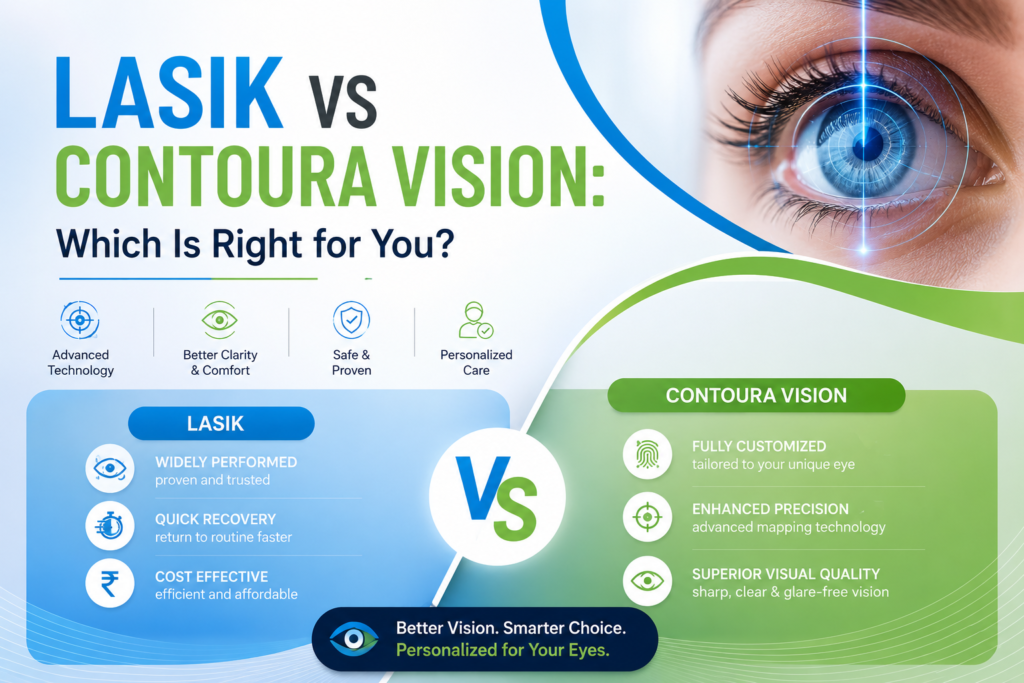
If you want the short version: Contoura Vision is a more advanced, blade-free, and highly customized upgrade to traditional LASIK. It maps your cornea in far greater detail (22,000+ points vs. LASIK’s standard correction), which often means sharper night vision, fewer glare/halo issues, and a smoother visual outcome. LASIK is still a safe, effective, budget-friendly option for many patients – but not everyone qualifies for it, and eligibility depends on your cornea’s shape, thickness, and prescription.
The only way to know which one is right for you is a proper eye evaluation. But let’s break down exactly what separates them.
What Is LASIK?
LASIK (Laser-Assisted In Situ Keratomileusis) is the most well-known laser eye surgery. A thin flap is created on the cornea (traditionally using a blade, though many clinics now use a laser for this step too), and an excimer laser reshapes the corneal tissue underneath to correct your vision – fixing myopia, hyperopia, or astigmatism.
Why people choose it:
- Fast procedure (10–15 minutes per eye)
- Quick visual recovery, often within 24–48 hours
- Decades of proven safety data
- Generally more affordable than newer technologies
What Is Contoura Vision?
Contoura Vision is a topography-guided, blade-free LASIK upgrade. Instead of using a generic, one-size-fits-all correction, it creates a 3D map of your cornea’s unique surface – including tiny irregularities standard LASIK can’t detect – and customizes the laser treatment to your eye’s exact contour.
Why people choose it:
- 100% blade-free (bladeless flap creation)
- Corrects minor corneal irregularities standard LASIK misses
- Often results in vision better than 20/20 for eligible patients
- Reduced risk of glare, halos, and night-vision issues
- Ideal for patients bothered by screen glare or night driving
LASIK vs Contoura Vision: Side-by-Side Comparison
|
Factor |
LASIK |
Contoura Vision |
|
Technique |
Standard laser correction |
Topography-guided, corneal-mapping laser correction |
|
Blade use |
May use a blade for the flap (or laser, depending on clinic) |
Completely blade-free |
|
Customization |
Standard, prescription-based |
Highly personalized (22,000+ corneal data points) |
|
Night vision quality |
Good, but glare/halos possible |
Typically sharper, fewer glare/halo complaints |
|
Recovery time |
24–48 hours |
24–48 hours |
|
Best for |
Straightforward prescriptions, budget-conscious patients |
Patients who want precision correction, night-driving comfort, or have mild corneal irregularities |
|
Cost |
Lower |
Higher (reflects the advanced mapping technology) |
Is LASIK or Contoura Vision Safer?
Both are considered safe, FDA-approved, and widely performed procedures with strong long-term track records. Safety isn’t really about which technology is superior in the abstract, it’s about which one matches your eye’s specific anatomy. A patient with a slightly irregular cornea may actually get a safer and more accurate outcome with Contoura Vision than with standard LASIK, because the treatment is tailored to their unique corneal surface rather than a generalized correction.
This is why an in-person corneal topography scan and eye evaluation always precede any recommendation — no reputable surgeon should recommend a procedure without first assessing your eyes.
Am I Eligible for LASIK or Contoura Vision Surgery?
Eligibility criteria are broadly similar for both procedures. In general, you may be a candidate if:
- You are 18 years or older with a stable eyeglass/contact lens prescription for at least 1 year
- Your corneal thickness is sufficient for safe laser correction
- You don’t have uncontrolled diabetes, certain autoimmune conditions, or active eye infections
- You are not pregnant or breastfeeding (temporary deferral)
- Your prescription falls within the treatable range for myopia, hyperopia, or astigmatism
Not sure if you qualify? A comprehensive eye check – including corneal topography, thickness measurement (pachymetry), and a dilated eye exam – is the only reliable way to confirm eligibility for either procedure.
Which One Should You Choose?
Consider Contoura Vision if:
- You want the most advanced, blade-free option available
- You’re bothered by glare or halos around lights, especially while driving at night
- You have a demanding visual lifestyle (long screen hours, night driving, precision work)
- You want the best possible chance at vision sharper than standard 20/20
Consider LASIK if:
- You have a straightforward, stable prescription
- You’re looking for a well-established, cost-effective option
- Your eye evaluation shows no corneal irregularities that would benefit from topography-guided mapping
Neither procedure is universally “better” – they’re different tools suited to different eyes. The real decision starts with a detailed corneal evaluation, not a Google search. If you’ve been putting off ditching your glasses because you weren’t sure which surgery was right for you, the best next step is a one-on-one consultation and eligibility check with a qualified LASIK/Contoura surgeon.
Ready to find out which procedure fits your eyes? Book a comprehensive eye evaluation to get a personalized recommendation.